Every Cuban Cigar Brand
An attempt to list all that are known
A National Cigar Museum Research Project
© Tony Hyman

![It’s been said that if you put two Cubans in a room together it is inevitable that they will find something to argue about. Government and politics are historic favorites, confirmed in a way by the endless series of major and minor revolutions that have been part of that nation for 300 years. Music and baseball are equal sources of debate. And so, I discovered when I visited the island, are historical topics as mundane as when was the first cigar band used, and by whom.
On an island where nearly everyone smokes, cigars and cigarettes are a matter of national pride, debate, and historical research. The question of who made or makes the best cigar is a natural, and one understandable to competition-minded North Americans. Less comprehensible to notoriously history-challenged residents of the U.S. is the Cuban propensity to want to answer questions such as “How many brands of Cuban cigars were there?”
Fifty plus years of research leads me to believe that, no matter how interesting that question may be to some, it is, and always will be, impossible to answer. But, like other fools before me, I shall try.
A difference between me and the various Don Quixotes that have preceded my efforts, is that I promise to make no claims of completeness...only to use all the resources I can to make the results as thorough as possible...the best such list compiled anywhere.
This goal began with the discovery of a list of pre-nationalization Cuban cigar brands published in Perelman’s Pocket Cyclopedia of Havana Cigars. His original list consists of 1750 brands, and acknowledges that many popular pre-nationalization brands were produced primarily for consumption in Cuba and not for export, and are thus not listed. Upon reading the list, I noted many well-known export names missing, among them Tip Top, Rifle, and Para Usted. These, and nearly 1,500 others I’ve identified, were not included in Perelman due to the limitations of the sources he used to compile his list. The sources are all worthy publications; they just aren’t enough. That list was compiled from:
[1] Ensayo de un Catalogo Universal de Marcas de Cigarros, by Isidro Sureda (Barcelona: I. Sureda, 1951) which is a fine contribution to scholarship but focuses on bands, and the evidence is that more than half the cigars sold weren’t banded.
[2] Registry of Exporting Manufacturers of the National Commission for Propaganda and Defense of Havana Tobacco. Another good source but it’s merely the Cuban government's official list of manufacturers licensed to export cigars in 1954. One-hundred and fifty years of brands aren’t included, nor are private house brands or cigars created for the domestic Cuban market.
[3] Enzo Infante's excellent history of the pre-nationalization Havana cigar industry, Havana Cigars 1817-1960 (Neptune City, N.J.: T.F.H. Publications, 1997). Like all books, this fine work is limited by what the author knows and / or chooses to share.
Notably missing are brands from the earliest years of the industry. It’s unfair to fault the compiler of Perelman’s list, as information from that critical, tumultuous, period is difficult, and often expensive, to obtain. The introduction to that list repeats Infante’s estimate that 800 brands existed by 1859. My research suggests Infante is way off base in that there had been more companies than that and that the brands that had come and gone by that date probably numbered five times that or more. Cuban companies tended to be short-lived, a series of quick business-oriented alliances, frequently lasting only a year, two years, three years, and then splitting, re-forming, being bought out, selling out...and disappearing. With the exception of a handful of long-lived manufacturers like Upmann, Bock, Cabañas and Partagas, most brands came and went, as did the companies that made them. Cuban record keeping was originally abysmal, and what records did exist were largely lost in civil war after civil war, and the theft and pillaging of Cuban Government records since nationalization. The NCM list includes more than 600 additional brands in existence before 1868.
Government registries do not provide all the answers because governments tend to be lazy and inefficient. Even when a government agency is a paragon of virtue and efficiency, they are compiling information from citizens who are often less than forthright. It’s well known that during the entire Spanish era Cubans smuggled every bit as much tobacco and cigars as they sold legally.
Another problem encountered when trying to compile a complete list of brands is nearly all Cuban export companies made scores of private label brands for wholesalers, retailers and special events. Some of these were made in quantities of a few hundred boxes...or fewer. Records are scanty.
The list you have here almost doubles that found in Perelman and other sources that have repeated it. I have been able to add so many brands to the list because for 55+ years I have collected THINGS. Things represent what people DO, not what they say they do. I own (and exhibit elsewhere in the Museum) a collection of the actual labels used by pre 1868 Cuban companies on cigars exported to Europe. I also own boxes, like the 1865 La Corona de España, imported from Cuba with brand names either never registered or simply omitted by compilers.
To aid in the compilation of this list, I turned also to catalogs of importers, exporters, wholesalers and retailers from the 19th century which contain prices lists of various brands and vitolas. Pre-WWI trade U.S. and British directories are also an important source of information. Those rare reference books listed scores of otherwise unrecorded companies and brand names. An 1874 Directory was particularly useful as it listed many “annexed” brands (those taken over by other companies). An importer’s 200+ page ledger from 1873 confirmed the existence of many of those brands.
For your added information and enjoyment I have color-coded my additions, and, in the case of more recently added names obtained from early ads or catalogs, also added the date of the source.
As you read this list, you will discover instances where minor differences exist between sources. The original list includes four variations of Partagas that certainly pertain to the same brand. Is is J.C. Ruiz or J.C. y Ruiz? Is it Rifle or El Rifle? Zouve or El Zouvo? Or both? Are these translation or recording errors or copy-cat brands? A great deal of evidence indicates early Cuban makers, like their counterparts in the U.S., were inclined to market cigars under names and designs similar to those of other more successful brands. Ybor’s copycat A Lo Figaro knock-off of the internationally popular Figaro is but one among many examples.
I make no claim that this list contains all brands, only that it’s more complete than any other list compiled to date.
You will find a few list entries that end in y (Spanish for “and”). To avoid using two lines for a single listing, the words Cia. or Co. meaning “Compania” or “Company” are sometimes omitted.
Additions or corrections to the list are always welcome. Please include your source,
<tony@cigarhistory.info>
Tony Hyman](All_Cuban_cigar_brands_files/shapeimage_2.png)

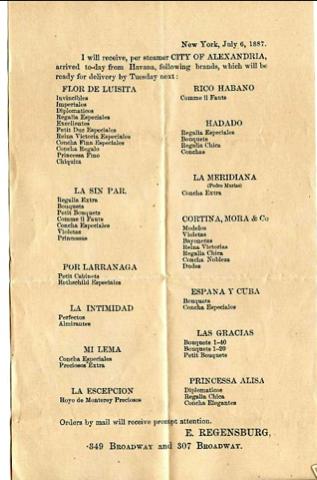
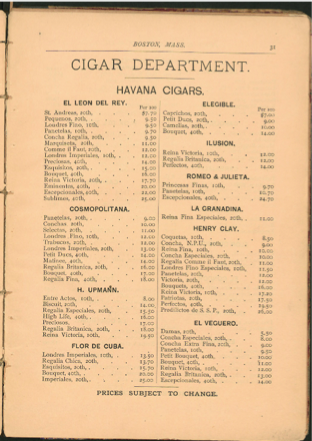
ABOVE: 1887 flyer from a New York cigar manufacturer and wholesaler regarding recently arrived Cuban cigars.
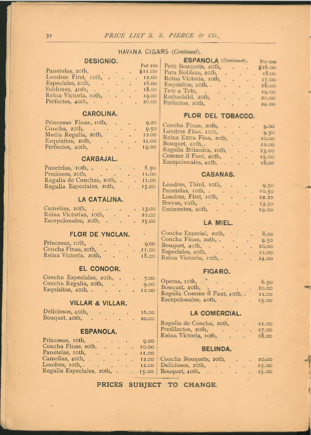
BELOW: 1886 S.S. Pierce catalog. Pierce was a high end gourmet food, wine and tobacco store in business
for 150+ years (starting in 1831) with 9 outlets in the Boston area.

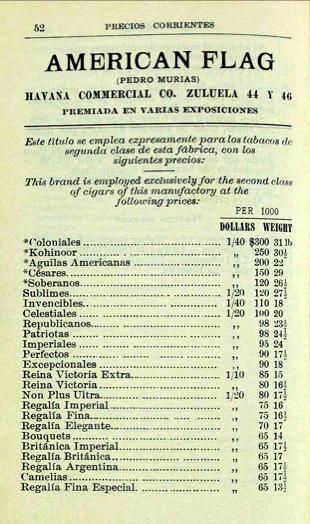
BELOW: page from a very rare paper-covered 386 page 4.75” x 6.5” anonymously compiled 1901 PRICES CURRENT OF THE HAVANA CIGAR FACTORIES published annually. This rare guide prices more than 130 brands and more than 10,000 sizes and shapes along with details about bands, foil, glass tubes, box sizes, etc.
Prices are quoted in Spanish gold.