Cuba
is the largest island in the Caribbean, located at the entrance to the Gulf of Mexico. It was on Cuba that Columbus first heard of people smoking, although he had already been presented with dried tobacco leaves, which he did not know what to do with, on San Salvador.
The Taino Indians, members of the Aruakos tribe who lived on Cuba, Puerto Rico and Hispaniola, cultivated tobacco and had developed drying and manipulation techniques for the preparation of chewing tobacco, snuff, cigars and a form of cigarette wrapped in leaves.
Indigenous people throughout the Caribbean are reported to have mixed coca leaves in with their home-rolled tobacco...a reasonable and logical practice. Some mixed coca leaves in with chewing tobacco, a practice learned from South and Central American natives. The Spanish conquerors did not get hooked on coca.
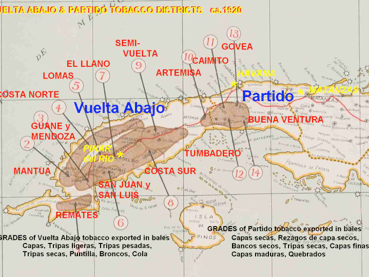
Cuba soon and rightfully became renowned for its cigar tobacco. Most famous has always been that from the Vuelta Abajo in the Pinar del Rio region of Western Cuba. The Vuelta was first planted in the 1700’s, and greatly expanded in the second quarter of the 19th century when demand for Cuban tobacco skyrocketed throughout Europe and the newly United States.
Vuelta Abajo tobacco became the standard against which all other cigar tobaccos are measured. Vuelta seed as well as seed from other distinctive regions <MAP> provided the original seed from which most cigar tobaccos have been developed.
Prior to 1800, cigar lovers seeking a smoke got it from from a street vendor found in town plazas from one end of Cuba to another. So many men, women and children smoked that small towns each supported a cigar factory, by King’s order. Factories were not allowed to see in neighboring towns.
Smokers wanting cigars got them from single-family “factories” on 16 acre farms and scattered in tiny towns. After 1800, the Spanish government allowed two Cuban cigar factories to make cigars for export. After 1817 Cuba’s cigar and tobacco business was opened. During the fifty years after Spain opened Cuba’s doors to limited trade the number of tobacco farms and cigar factories in Cuba rose dramatically. The number of farms kept growing. Factories tended to be short lived, due to attrition, absorption or mismanagement.
One international directory compiled in the early 1870’s, during the heart of Cuba’s Ten Year’s War, lists 200 principal marcas being supplied to the export cigar trade by 200 companies, each of which owned as many as twenty other marcas (brands they were entitled to make), absorbed from former rivals or partners.
The entire 19th century in Cuba witnessed continual, seldom overly popular, frequently bloody, uprisings against Spanish control. As a result, both Cuban Spaniards and Cuban creoles (mixed bloods of Spanish, Indian, Black, European and Caribbean backgrounds) often moved to the United States, settling primarily in New York, New Orleans, Philadelphia and Key West, four cities reachable by commercial ship lines.
As the 1800’s progressed, the once small factories scattered throughout all of Cuba were absorbed into larger Havana centered operations, though outlying factories were frequently kept open to handle spikes in demand and to supply locals. The increased imperson-alization of factories containing up to 1,000 employees led to increased alienation of workers and moves toward unionization. Unionization was one of many reasons encouraging experienced cigar makers to take their marca (cigar brand) and start a factory in New York, New Orleans, Florida or California.
Cuba’s devastating 10 years war (1868-78) nearly destroyed the island physically and economically with some estimates claiming 25% of the male population dead. Skilled cigar makers and factory managers had yet another reason to flee northward, primarily to New York City during the great expansion of US cigar factories which began in the late 1870’s. Cuban refugees also went to Mexico, South America and Europe, carrying techniques and procedures of Cuban cigar making throughout the world.
The country wrecked, the population more than decimated, fields burned, government money embezzled, rail lines in shambles, sugar plantations burned or plundered, the situation was favorable for foreign investors. After 1880 Cuban cigar factories and fields came increasingly under the control of American, British and German interests. By World War One, less than 50 independent Cuban factories remained to supply the world’s export market. Famous Cuban marcas such as La Corona, Bock y Ca., Antonio y Cleopatra, A de Villar de Villar and Henry Clay were ultimately owned by American Tobacco Co. and manufacture moved to an air conditioned US Bonded factory in New Jersey during the 1930’s. In the 1960’s, many of the remaining famous marcas were taken by their owners to Honduras, The Canary Islands, and elsewhere.
Debates still rage over ownership of various marcas and quality of product being sold under them, but customers world wide continue to absorb this tiny island’s entire export production. To this day, Cubans smoke half of the island’s total output.
The Cuban cigarette industry was thriving by the mid 1800’s. Very short hand rolled cigarettes, frequently made of scraps of high grade cigar tobacco, were extremely popular with the total output split 50-50 between local consumption and export. Europe and South America were the biggest customers. The largest and most famous of Cuban 19th century cigarette makers was La Honradez, the subject of books and articles in Europe and a popular tourist stop for visitors to Cuba during the second half of the 19th century.
Honradez is credited with creating the earliest tobacco item designed to be a collectible in the 1850’s when they began wrapping each pack of 10 to 20 cigarettes in colorful cartoon wrappers featuring jokes, fables, uniforms, moral lessons, famous people and of course, pretty girls. The frequent changing of labels was an effort to thwart European pirate wholesalers and retailers who were marketing fake Honradez cigarettes. Honradez was a target of forgers because their cigarettes were regarded as the world’s finest and cost three times what domestic cigarettes cost worldwide. In the 20th century the Cuban cigarette industry focused on domestic markets as it was not in a position to compete against the marketing power of American, British and French cigarette conglomerates.
Contemporary Cuba is a country everyone seems to have an opinion about. These same folks, alas, hold those opinions with little or no knowledge of what has been going on in that tiny Caribbean Eden for the past 500 years. It’s an amazing story filled with revolution, war, U.S. invasions, foreign ownership, corruption at every level, jaded citizens and a lot more. Little by little I plan to tell that story...so come on back and visit again.