Nailed wood boxes of 250 are one of the oldest forms of cigar box, dating back to the earliest days of international commerce in cigars. In the first half of the 1800’s these were called “quarter boxes” as a “box of cigars” contained 1,000. In 1865 they became one of the five official sizes of cigar box permitted by the federal government. Although boxes of 500 were also legal, they proved impractical and boxes of 250 became the largest boxes of cigars in regular commerce.
        In the second half of the 1800’s large boxes were used for cheap (frequently 3/5¢) cigars, and were typically trimmed with inexpensive mono-chromatic labels making those with colorful labels fine prizes for collectors today. The use of large boxes for cheap cigars was a matter of economics. Profit margins on cigars in general were small, but downright miniscule on cigars that wholesaled for a penny or penny and a quarter and retailed at
3/5¢. One box that would hold and display 250 cigars was a lot cheaper to obtain from the box maker than five boxes that held 50 each. Less wood, less labor, and many fewer labels resulted in a few more pennies in the cigarmaker’s till.
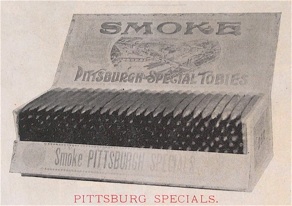
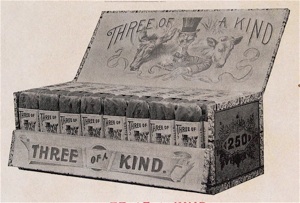
Photos from 1897 Jenkinson catalog    [2056] [2053]
        Most, but not all, NW 250 boxes have dropfronts so that customers can see the cigars, whether packed laying down or upright in bands, sleeves or paper bundles. Dropfront boxes require an overall lid, rather than an inset.  Over the years, many empty 250’s have had their dropfronts  nailed shut by owners attempting to make the empty box useful. Most surviving NW 250’s appear to date 1883-1909 and the vast majority held cigars made in Eastern Ohio or Western Pennsylvania.

 
Boxes of 250 (& 200)
A National Cigar Museum Exclusive
(c) Tony Hyman
 
One of the most common 250’s, here with nailed dropfront. P.Whitlock sold to American Tobacco Co. mid 1890’s who transferred it to American Cigar Co. c.1905 who passed the brand to P.Lorillard in 1911.
Lorillard offered the brand until WWII.  [11036]
Few 250’s had end labels, since boxes this large were rarely stacked on shelves in such a way they could be seen. The cigar industry was never one for unnecessary expense.  This is by American
Tobacco Co. in 1898. [11038]
Named after a popular political issue of the day.
Very typical simple text B/W inner and drop labels. Cigars by Shearer & Co., Windsor, PA
Factory 738, 9th PA, 1901.
[10726]
Pictorial B/W inner of children smoking while sledding makes this a prize for collectors.
Cigars by Heed Bros., Barnesville, Ohio
Factory 17, 18th tax district Ohio, 1893.
[4405]
First 250 I owned (1955). Cigars by large (200 roller) Cincinnati factory specializing in cheap cigars,
Roth, Bruner & Feist, Fact. 387, 1st Ohio, c1888.
Cigars cost 3/5¢.
[4402]
Another Roth, Bruner & Feist brand. Label printed in red, blue and silver, late 1890’s. Box of 200. Smaller (25) boxes of these were given away when dealers
bought WAR EAGLE cheroots. These were bundled
5 to a package for a dime.  [4403]
Dramatic full color label depicting the just completed Spanish-American War highlights these cheroots.
Another Roth, Bruner & Feist 3/5¢ brand made in
their Fact. 387 in Cincinnati. 1899
[3120]
Roth, Bruner & Feist box of 250, 1890’s.
When a number is part of a brand name it almost always means the cigars were sold in bundles that size. The 3/5¢ pricing confirms it in this case.
[4407]
W.H. Kildow of Tiffin, Ohio, was another good-sized maker of cheap cigars in the 1890’s.
Fact. 215, 10th Ohio
[4431]
A classic American advertising theme. Simple but strong graphic appeal. Cheap B/W label.
Swisher Bros., Fact. 59, 11th Columbus, OH, 1899.
A curator’s favorite.
[4422]
Another Swisher Bros. product, these made in
Fact. 15, 11th Ohio (Newark) c1895.
Note the cute pricing: 345 (3/5¢).
[4409]
Distinctive label printed in only three colors. Cigars by J.F. Cherry, Newark, Ohio Fact. 143 10th OH.
3/5¢ cigars, c.1905.
[4408]
A lovely Ohio dropfront that’s been nailed shut.
In my opinion one of the most attractive
250 boxes ever marketed. 1898
Not in the NCM collection.
[w73106]
Another of the more colorful Ohio 250’s.
Not in the NCM collection.
[w08634]
Hoboes and salesmen, two kinds of roadmen
featured on this 250 dropfront with an
inexpensive three color label.
Not in the NCM collection.
[w0250]
Deserving to be included in the exhibit of bad brand names, loose labels for 250 boxes are rarely found because of their size. The word “Segarros” is a meaningless misspelling. The packs of 3 cigars are a good example of cheap cigar packing. [1611]
Down town Pittsburgh and the confluence of the two rivers. The catalog illus of this box is pictured
in the introduction to this exhibit. Pittsburgh was home to many stogie and toby makers.
Fact. 231, 23rd PA.  [4418]
Another Pittsburgh cheapie, this made by Collins Cigar Co., Pittsburgh, Fact. 6, 23rd PA. This same dramatic, but monochromatic, graphic appears with names of other cities.
[4416]
Another Pittsburgh box with plain monochromatic label typical of boxes of 250 cigars. Monochromes don’t dominate this exhibit only because the NCM rarely buys them. Fact. 470, 23rd PA. Floto Bros, Meyersdale, PA 1900     [4419]
This box is covered, front, back, top and inside with this monochromatic racist label of boys chasing a cigar butt lying in the street. Another Collins Cigar made in Fact. 6, 23rd PA. 3/5¢ 1899.
[1669]
J.H. Lucke, one of Cincinnati’s largest factories, used this racist monochromatic box for its 3/5¢
cigars in 1903.  Fact. 567, 1st Dist. Ohio.
[1678]
Keystone Cheroot Co., Fact. 2230, 9th PA, in Hanover used this around 1902. Note how a label designed for a 50 box doesn’t fit a 250, emphasizing the difference in counter space they take up.
[N0250]
A standard 50 box inner looks lonely on this extra long 16” wide 250. Cigars by Sutro & Newmark, whose 1000 roller Fact. 412 in NYC was one of the nation’s largest, 1880’s.
[4412]
Another example of the loneliness of a 50 box label on a 250 box. Vanity labels are rare on large boxes.
J.H. Lucke’s 100 roller Fact 567 in Cincinnati, 1st tax Dist. OH, c1904.
[6458]
Very long at 18+ inches, the box is unusual in using a real photo on photo paper as a label. Pictures hotel, staff, and station-vehicles. Rare too as it’s not a dropfront. Fact. 11, 9th PA (Warren Beck) c1890. The 2nd 250 box in the NCM.  [6494]
Important maker W.H. Lucke’s knockoff of the popular OLD VIRGINIA CHEROOTS sold for 3/5¢.
Dropfront is larger than most, demanding space in front of the box. A “space hog” disliked by retailers.
Fact. 567, 1st OH Cincinnati, c1905.  [4424]
Unusual dropfront that lies flat would have been hated by retailers, most of them ripped off to avoid giving up wasted space in a counter. Early 1880’s. Patented box with catches at both top corners.
[3371]
This colorful patriotic 250 held 5¢ cigars made by S. Hernsheim’s La Belle Creole cigar factory in New Orleans who claimed in 1894 to have the nation’s largest output.  Fact. 511 Louisiana made for Chicago wholesaler Durand & Kasper.  [4421]
Extra large box and label highlight this box.
Fact. 1396. 9th PA, c1903.  Cigars possibly made
by W.H. Riddle, Holtz, and sold for 5 for 10¢.
[4414]
Cheroots in this two color labeled box were made in Fact. 61, 2nd Virginia by the Try-Angle Cigar & Cheroot Co, Richmond, VA.  c1890. Cheroots and stogies are specific types of cigar, not accurate synonyms for cigar, though used that way.  [4413]
Plain two color label used by the Orrison Cigar Co.
of Bethesda, Ohio, Fact. 865, 18th OH, c.1915.
[4410]
Early (c1885) dropfront with simple Black/Gold label.
Extra large dropfront panel is almost full size, making it one of those retailers hate. Metal clasps on front corners. Fact. 1795, 9th PA.
[4490]
Two color label used by unknown owner of Fact. 704, 23rd PA (Pittsburgh?} in late 1890’s, perhaps to celebrate the coming of electricity to a small town.
Not a dropfront.
[4415]
NCM Home        Wooden Boxes        Earliest Boxes