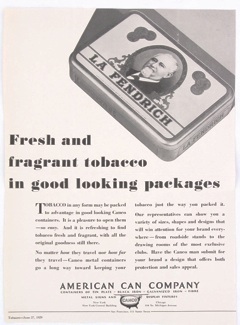
The 10/5 Pocket Pack was introduced in 1910, when the law was changed to allow ordinary size cigars to be packed 10 in a box (like little cigars).  A 10/5 is a box of 10, two rows deep with 5 cigars in the top row, by far the most common way of packing 10 cigars. Most popular 1910-1940. Most pocket packs were lithographed on tin, but a few paper labels have been found.
 
        The ad was placed in June of 1929 by the San Francisco branch of American Can Company.



Pocket 10 Packs
A National Cigar Museum Exhibit
© Tony Hyman
Webster Cigar Co., Fact. 7  Detroit, Mich,  1926.
Typical example of a hinged 10/5 box.
[2962]
Frank P. Lewis Cigar Co., Fact. 439 Illinois, 1920’s.
[2965]
Davis Cigar Co., Fact. 320 Coffeyville, KS, c1925.
Condition poor; a placeholder.
[2963]
Webster Cigar Co., Fact. 153, 1st Michigan.
An attractive 1920’s design.
[2964]
Fact. 9 Virginia, 1920’s.  The frontmark (size and shape) refers to General Blackjack Pershing,
a flamboyant leader in WWI.
[2967]
Long-lived brand by Diesel-Wemmer Corp., made in their premier Factory 77, 10th Dist. Ohio   1920’s.
Factory was on Elm Street in Lima, Ohio.  
[2968]
Fact. 28  Iowa  1920’s.
[2966]
American Tobacco operated 40 US factories.
Fact. 112 in 1st tax Dist. New Jersey
used this slip top tin in the 1920’s.
[2996]
Rare 10/5 sliptop made around 1930 by the aptly named Mi Wauki  Cigar Co., in Fact. 368 Wisc.
on National in Milwaukee. Not in NCM collection.
[w0000]
Fact. 493 Maryland filled this tiny (less than 3” long) tin rectangular 10/5 hinged box with 10 little cigars (cigarette size) around 1920.  
[2981]
Barnes-Smith Co., Fact. 324, 21st District of NY, Binghamton c1920. Hinged tin box with unusual match-striker built in the back of the box.
[3560]