The first novelty packaging appears to have been boxes shaped like books. Book-shaped boxes were similar enough to standard NW 50/13 boxes that they didn’t raise the ire of IRS and were permitted before the law of 1878 made novelties ubiquitous. Book boxes are found in 10, 12 and 100 boxes, but those are rare compared to the flood of more standard 25/13 and 50/13 packages. Book shaped boxes vary greatly in the degree of realism offered.  The vast majority of book-shaped boxes were intended as Christmas gifts and carry Holiday themes, but only a few are included here. Most of the NCM Christmas books can be seen in the NCM Christmas exhibit. Christmas books frequently carry no indication of maker or brand name, tho a few “name brand” cigar companies offered them as well.
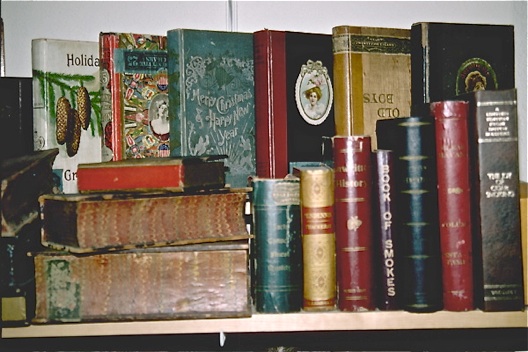
Book-Shaped Boxes
A National Cigar Museum Exhibit
(c) Tony Hyman
 
Selection of books hinting at the
huge variety available.
[3303]
More variety. An upstate NY bookstore owner friend has more than 100 different book-shaped boxes,
25 of which I gave him in exchange for the LA ESCEPCION chest seen elsewhere in the NCM.
[3302]
Earliest book in the NCM collection, made in 1876.
Box is “framed,” a boxmaker term for four wooden sides and cardboard top and bottom. The thinner
cardboard adds to the realism of the presentation.
[3324]
This type latch is frequently found on early books. Without it, contents would spill out when the
box was stood vertically on a shelf.
[3325]
Die-cuts are often integrated into cigar box designs
in the 19th century. Froude was the cigar maker.
Factory 408, 2nd District NYC.
[3326]
The cigars sold for 10¢ each, $4.50 a box according to hand-written notations on the Caution Notice.
That was fairly pricey at the time, though cigars
as high as $1.00 each were available.
[3327]
Framed box (wooden sides with thin cardboard top and bottom) textured and colored to
look like old leather.
[9521]
Clasp is curved to match the curved “pages”
and spine. Registered in 1876, sold in 1879
by Manhattan’s J. Holzman, an early
creative packager of cigars.
[9520]
The label style is typical of late 1870’s and early 1880’s, with its central square and twin flanking decorative panels. Box is lined with a foil-like paper
often indicative of Christmas use.
[9524]
The most common book-shaped box, used by cigar makers coast to coast around 1900. My first book-shaped box was a LONGFELLOW discovered in a California bookcase when I was 14. Colorful swirls on the fore edge are common.  [3307]
Not all books had latches. This 1885 box exterior is typical of the period, and the earliest example of
a CN printed directly on the box (POB).
Fact. 803, 9th Dist. PA.
[3312]
Brand names were frequently missing from inside labels in the 1860’s but unusual to not find
in boxes as late as 1885.
[3332]
Unusual 1883 book box of 100/26 used by
Vallencia Cigar Factory, 64 Wabash, Chicago
for J.I. Meyer & Bro. of St. Louis.
Cigars made in Fact. 638, 1st Illinois.  
[3316]
Great satirical medical label. The Vallencia
Cigar factory had 150 rollers making it Chicago’s largest, almost 3x the third largest. Berriman Bros.
with 140 was second largest.
[3317]
Unnamed Christmas box. This is the bottom of the box. Note the cut-out in the center, exposing the legally required Factory ID stamped in the wood.
[3333]
Covering objects with cigar bands was a popular hobby 1900-1920. The label on this Christmas box
imitated the fad. Fact. 151, 3rd Iowa  c1913.
[3309]
Rare 12/6 featuring a boy peeing his Christmas greetings in the snow.  Cigars by Chas. Specht Noonday Cigar Co., Fact. 505, 1st Missouri,
St. Louis, 1904. A curator’s favorite.
[3305]
Not too many books were used for
custom brands.  Fact. 481, 1st PA.
Was this actually sold or given  away
at the convention?  ¿Quien Sabe?
[3308]
Ordinary looking book, Havana 1910.
A curator’s favorite.
[3342]
But open it up and find a hidden treasure by
one of Cuba’s most innovative packagers,
Francisco Fonseca, 1910.
[3343
The inner label of the box pictures
F.E. Fonseca, who operated cigar factories
in Havana and New York City.
[3344]
SUPREME SENSATIONS, a very realistic looking
book box from Fonseca’s New York Factory.
A curator’s favorite.
[3339]
Another view. Thin cardboard covers with a leather feel add to the book illusion. F.E. Fonseca’s
Factory 206, 2nd Dist New York City, 1926.
A curator’s favorite.
[3340]
Inside, the box is “Dedicated to J.M. Porter as a special mark of esteem” and personally hand-signed by Fonseca. Factory located at 150 Duane St. NYC.
Tax stamp cancel suggests it was a Christmas gift.
[3341]
Cuban not particularly realistic all wood
inlaid “book” by Segundo Lopez,
Havana, Cuba  c1900.
[3346]
Red cedar not particularly realistic box of 100
filled in Factory 45, 1st PA in the 1930’s. These SWEETEST STORY EVER TOLD turn up regularly.
In general, book boxes seldom contain 100 cigars.
[3353]
One of history’s all time most popular book boxes with attractive simulated alligator cover. Made by
Cuesta Rey, Fact. 55 Florida in 1939.
[3321]
Elegant Christmas package has a wooden
flap with a lift tab. Tax stamp used legally
but hidden so it didn’t interfere with
good looking exterior.
[3320]
PLEASANT MOMENTS 10/5 small redwood book
by El Monte Cigar Company, Fact. 44,
6th District of California. 1930’s
[3350]
EL CORT brand produced this Book of Smokes
in the late 1930’s. Fact. 244, 1st Calif.
Redwood 10/10.
[3351]
Packaging innovator DUTCH MASTERS brings out a
modern cardboard book.
[3315]
 
[3318]
Modern book-shaped box made by Fredman Torres, Boxmaker, for HOYO DE MONTERREY HONDURAS.
[11025]
Interior of previous. Note magnetic latch.
Embossing on coins is simulated.
[11026]
Selection of four other Torres titles. Any given title may appear in more than one color. The burgandy
EXCALIBER above, is red here. This assortment of books is not in the NCM collection.
[w00411]
5 book set by American Tobacco for its New Jersey made LA CORONA brand, each 10/5 box holding a different frontmark (size) “especially selected from the fine library of La Corona cigars for Mr. Cyril G. Hetsko, Christmas 1970.” Hard to find.   [3319]