In the pre-Civil War era when most cigars were shipped from the factory in boxes containing from 200 to 5,000 cigars, cigars were bought loose in ones, twos, etc., and carried by middle and upper classes in personal painted combination papier maché and leather pouches, almost all of which appear to be of European origin. By the mid 1850s personal cigar cases were also made of leather, silver, silver plate, tin, and tortoise shell. They are briefly examined in another NCM Exhibit.
 
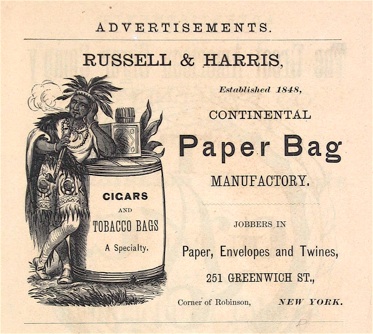
     Inexpensive machine-made paper bags appeared in the 1840’s and became a staple of commerce. Machine-made cardboard containers followed in the 1850’s. Paper bags were particularly convenient for casually and inexpensively packaging cigars. Makers who offered multiple pricing like 3/5¢ found that pre-packaging their cigars in paper pouches was an inducement to buy multiples. Paper and cardboard had the advantage of being easily printed, so pouches and bags became post-sale advertising, reminding the smoker of what he was puffing on or where he bought it. The fancy hand-painted leather-papier maché pouches aren’t seen as much after the Civil War, though some interesting variations  in cloth and leather give-aways appeared, and were given away free or offered as premiums by sellers. The free cardboard and paper pouches remained in use to WWII.   [3721]

 
Pouches & Bags Gallery
A National Cigar Museum Exclusive
© Tony Hyman
The earliest paper bags were simple, colored, and carried brief messages. Tobacconist S.A. Thayer operated in Boston in the 1860s.
[3688]
The Kurtz’s operated in Millville in the 1870s, 80s and 90s. The Indian is a stock printer’s design.
[3717]
Affter uniform machine-made cardboard appeared on the market in the early 1850s, it was used for pouches for holding a few cigars. Some pouches like these were filled at the factory, others by the retailer. These were almost always used for
two-fers, three-fers and four-fers.  [3689]
Early style cardboard.
[3695]
This 1870s and 80s one-man factory sold cigars
wholesale and retail, both those he made and those
purchased from other makers.
[11801]
Close-up of printer’s stock image
used by Wilkens on his bags.
[11802]
Seldon Risley of Brooklyn was granted a patent for a cardboard throw-away cigar case that “may be made with appropriate inscriptions, and so cheaply that it will serve as an inexpensive advertising medium” which could be supplied free to dealers and customers.  December 15, 1868.   [5197]
S.R. Wilmot of Bridgeport, CT, designed this cigar case to be made of tin or pasteboard. Patent granted February 23, 1869.
[5198]
T.H. Kelly, Advertising Specialities of Schenectady marked his case “Pat. Applied for” but it appears to be an exact adaptation of the Wilmot patent.
[3674]
Pouches were printed then die-press stamped
when slightly moist.
[3675]
Perhaps history’s biggest user of light-weight paper pouches. Whitlock, American and Lorillard used 2, 3 and 4 cigar pouches for this brand for 50 years.
[3687]
Fancy printed pouch for a single cigar, made of cardboard and accordion fold tissue. European.
Probably applied by the retailer, but not known.
[3684]
Similar, less expensive, all paper pouches for single cigars, supplied in perforated strips. Though not known for certain, believed to have been applied
by the retailer.  United States, pre WWI.
[3686]
Attractive see-through paper pouch, believed to be European, lacks brand identification.
[3685]
Hummel & Co., a major Binghamton cigar company used this card-stock pouch at the turn of the century.
[3690]
Justin Seubert, a major Syracuse cigar company used this card-stock pouch at the turn of the century.
[3691]
Distinctive card-stock pouch used by one of New England’s best-known long-time brands.
[3693]
Reverse of accordion pouch, depicting
Waitt & Bond factory.
[11805]
The price reduction and blocking out of the “Union Hand Made” notation suggests the company began making cigars by machine. Probably 1920s or 30s.
Brand name was one of many rip-offs of
R.G. Sullivan’s famous 7-20-4
[3692]
J.B. Back was known for quality cigars.
These were available at 10¢, 2/25¢, 15¢, 3/50¢,
all standard pricings from 1900 to 1960.
[3694]
This  brand of cigars was also a well-known brand of smoking tobacco, though the latter was made by a different company. Bag is probably Pre-WWI.
[3698]
 
[3699]
American Tobacco Co. advertised their automobile give-away on bags for ROI-TAN cigars
[11690]
Twenty-five words or less and five cigar bands gave you the opportunity to win a new Chevrolet.
Enter as often as you wish.
[11691]
Counter-top display for the give-away.
[Not in the NCM collection]
[Not in the NCM collection]
Everyone won. Millions of folks got cars they couldn’t drive, winning a small metal
automobile charm, a popular sight on ebay today.
[11687]
How some three-fers were sold
in cardboard pouch-bags.
[7327]
This giant company was best known for EL VERSO and SAN FELICE but made a number of others as well. In 1929 it became D.W.G.
[3696]
Two cent cigars by one of Ohio’s largest factories. See examples of their boxes in the Exhibit
of boxes of 250.
[3697]
Reverse side of the Roth, Brunner & Feist cloth and the D-W and Justin Seubert paper bags.
[3600]
The reference to Indian Territory marks the sewn cigar pouch on the left as pre 1912. The cloth pouch on the left held 4 fairly small cigars.
[3683]
Because they were generally very inexpensive, cigar scraps and clippings were often sold
in paper bags.
[11807]